Starter, battery, or alternator: the three get blamed interchangeably in Forest City parking lots, usually by whoever is holding the jumper cables. They are three different jobs in one system. The battery stores the power. The starter spends it in one heavy burst to crank the engine. The alternator refills the battery and runs the car's electrics once the engine is going. Because their jobs differ, their failures sound and look different, and a few minutes of ordered checking separates them far more reliably than swapping the easiest part first.
Work this checklist in order. Each line has a pass sign and a fail sign, and the pattern of passes and fails names the culprit before any money moves.
The symptom checklist, in order
- Single loud click, engine does not crank: Power is reaching the starter circuit but the starter is not turning, or cannot. Fail points: worn starter solenoid contacts, a worn starter motor, or a connection too corroded to pass cranking current. A battery too weak for the job can imitate this, so it does not pass the starter yet.
- Rapid clicking when you turn the key: Classic low-voltage sign. The battery has enough power to engage the starter repeatedly but not enough to crank. Fail points: discharged or failing battery first, corroded terminals second. This sound almost never means a bad starter.
- Slow, labored cranking, especially cold: The starter is working but starved or tired. Fail points: weak battery, high-resistance cables, or a starter whose internal wear makes it draw excess current. A current-draw test separates them.
- Cranks normally but will not start: Pass for the whole starting system. The starter, battery, and cables just did their jobs. Look elsewhere: fuel, spark, or a security system fault. Do not replace starting parts for this symptom.
- Grinding noise during cranking: Fail point: the starter drive gear or the flywheel teeth it engages. Repeated grinding damages both, so this one should not be lived with or retried hopefully every morning.
- Battery light on while driving, lights dimming at idle: Fail point: the charging system, meaning the alternator or its belt and wiring. The starter is not involved at all once the engine runs. Note the car is now driving on battery reserve alone.
- Starts fine after a jump, dies again by tomorrow: Could be either system failing to do its half: the alternator not refilling the battery, the battery not holding the refill, or a draw draining it overnight. This pattern needs both tested, not a coin flip.
- Headlights brighten and dim with engine speed: Fail point: alternator output or voltage regulation. Healthy charging holds voltage steady; visible swings say the alternator or its regulator is struggling.
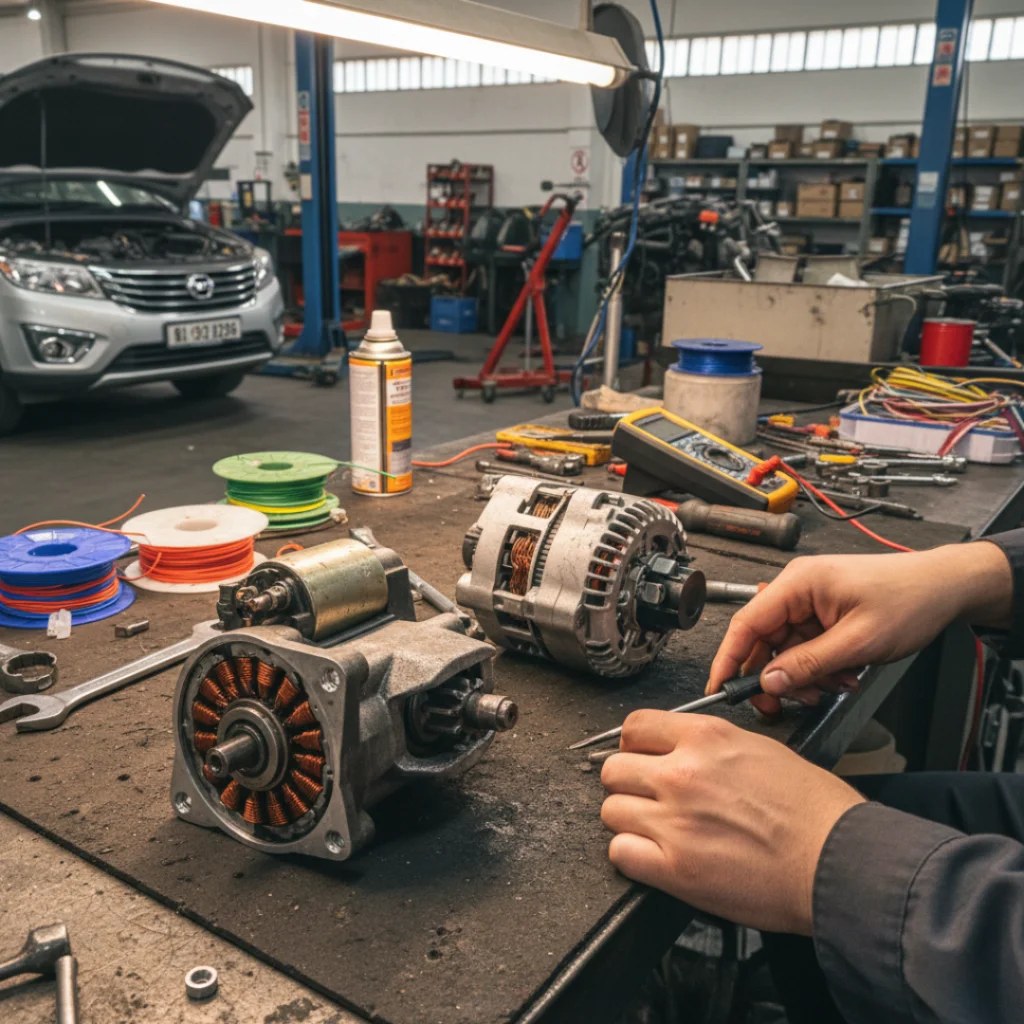
The one distinction that settles most arguments
Timing. A starter can only fail you at the moment of starting, because that is the only moment it works. An alternator can only fail you while driving or in the hours after, because its work is charging. If the car cranked strongly, drove across town, and then showed a battery light and dimming lights, the starter is innocent no matter how the story gets retold. If the car drove perfectly yesterday and gives one click this morning after a quiet night, the alternator almost certainly did its job yesterday and the argument is between battery, connections, and starter. Sorting by when the symptom lives eliminates a third of wrong parts before testing begins.
The tests behind the checklist
Three measurements do most of the professional work. A battery test under load shows whether the battery can deliver cranking power, not just show voltage at rest, which can look fine on a battery that collapses under demand. A starter draw test measures how much current the starter pulls while cranking; too much means internal wear or a struggling engine, too little with a click means resistance in the circuit. A charging test measures alternator output and voltage at the battery with the engine running and loads on, lights, blower, and rear defroster, because an alternator can pass at idle with no load and fail the moment it is asked to work.
Connections get inspected through all of it. A green, swollen cable end or a loose ground strap can fail every one of these tests with all three major parts healthy, which is why a shop like Forest City Starter tests the circuit and not just the components.

How the three conspire
The cruel part of this system is that each failure recruits the others. A weak alternator undercharges the battery, and a chronically undercharged battery loses capacity and then gets blamed for no-starts. A dragging starter overworks a good battery until it is no longer good. A battery at the end of its life makes a healthy starter sound tired. This is why the checklist ends in tests rather than verdicts from sound alone, and why replacing one part without testing the other two so often produces a second failure a month later, wearing a different name.
Common questions
If it starts with a jump, does that prove the battery is bad?
No. It proves the starting circuit works when given enough power. The battery may be discharged because the alternator is not charging, or drained by a draw overnight. All three need testing before that jump tells its story.
Can a bad starter drain the battery?
Rarely while parked, but a worn starter can draw excessive current while cranking and drag a marginal battery down with it. The overnight-drain suspect list is led by lights, modules, and alternator diode faults, not starters.
My car clicks once and the dash lights go out. Which is it?
That pattern most often means a connection failing under load, or a battery collapsing completely under demand. Have the terminals and cables checked along with the battery before condemning the starter.
Photos in this guide are representative stock images.
← All guides from Forest City Starter← Back to Forest City Starter